Pearson Edexcel · GCSE · Music
Course version: 1MU0 · Version from Sept 2016
Musical vocabulary - Dynamics and performance matters: A slide between…
Full specification wording
Appendix 3: Musical vocabulary - Dynamics and performance matters: A slide between adjacent notes of a chromatic or diatonic scale. The terms glissando and portamento are to some extent interchangeable, but a portamento involves movements smaller than a semitone (such as a singer can achieve but a pianist cannot)
A slide is a continuous pitch movement linking two notes rather than a clean jump.
- Point 8 of 25
- 4 key terms
Study notes
From the teaching notes for this specification point.
The idea
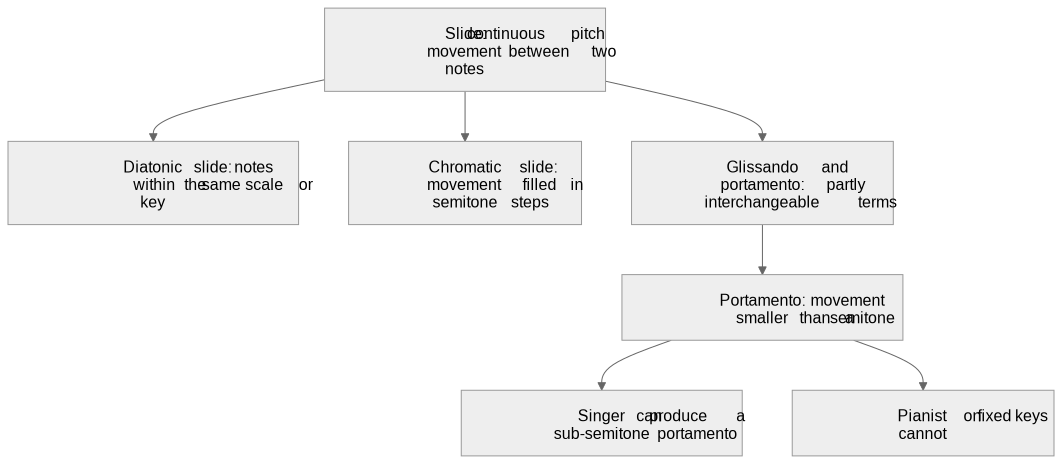
A slide is a continuous pitch movement linking two notes rather than a clean jump. In a diatonic slide the two notes belong to the same key, so the movement passes through the scale steps between them; in a chromatic slide the movement fills in semitone steps. Glissando and portamento are often used loosely as synonyms, but the specification draws a distinction: a portamento is a slide of less than a semitone, a microtonal glide. A singer can bend a note by a fraction of a semitone, and a string player can slide a finger slightly, but a pianist striking fixed keys cannot produce that fractional movement. So a piano can glissando across white or black keys, yet cannot truly portamento. When answering, identify the interval spanned, whether the notes are diatonic or chromatic, and which instrument can physically realise the fractional slide.
What earns the marks
- A slide is a continuous pitch movement between two notes, not a detached leap.
- A diatonic slide links notes within the same scale or key.
- A chromatic slide fills the movement in semitone steps.
- Glissando and portamento are partly interchangeable terms.
- A portamento is a movement smaller than a semitone.
- A singer can produce a sub-semitone portamento; a pianist on fixed keys cannot.
Common mistakes and how to put them right
Assuming a piano can perform a portamento.
Put it right: Fixed keys cannot produce a movement smaller than a semitone.
Confusing a slide with a leap or a trill.
Put it right: A slide is continuous pitch movement between adjacent notes.
Exam tips
- Read the question stem for the words diatonic or chromatic and match the interval described.
- When an instrument is named, check whether it can physically produce a sub-semitone glide before choosing portamento.
- Eliminate options that describe detached leaps or ornaments rather than continuous slides.
Try the lesson
The start of the Appendix 3: Musical vocabulary - Dynamics and performance matters: A slide between adjacent notes of a chromatic or diatonic scale. The terms glissando and portamento are to some extent interchangeable, but a portamento involves movements smaller than a semitone (such as a singer can achieve but a pianist cannot) lesson, made from teaching notes for this specification point.
Have a go first
A performer slides smoothly from one pitch to the next, passing through pitches that lie between the two notes. The slide covers a distance of less than a semitone, as a singer can produce but a pianist cannot. Which term describes this type of slide?
Listen
A slide is a continuous pitch movement linking two notes rather than a clean jump. In a diatonic slide the two notes belong to the same key, so the movement passes through the scale steps between them; in a chromatic slide the movement fills in semitone steps. Glissando and portamento are often used loosely as synonyms, but the specification draws a distinction: a portamento is a slide of less than a semitone, a microtonal glide. A singer can bend a note by a fraction of a semitone, and a string player can slide a finger slightly, but a pianist striking fixed keys cannot produce that fractional movement. So a piano can glissando across white or black keys, yet cannot truly portamento. When answering, identify the interval spanned, whether the notes are diatonic or chromatic, and which instrument can physically realise the fractional slide. A strong answer earns marks for these points. A slide is a continuous pitch movement between two notes, not a detached leap. A diatonic slide links notes within the same scale or key. A chromatic slide fills the movement in semitone steps. Glissando and portamento are partly interchangeable terms. Exam tip: Read the question stem for the words diatonic or chromatic and match the interval described.
See it
Key words
Say what each word means before you turn the card.
Slide
Try answering aloud or in your head before turning the card.
Diatonic slide
Try answering aloud or in your head before turning the card.
Chromatic slide
Try answering aloud or in your head before turning the card.
Portamento
Try answering aloud or in your head before turning the card.
See every definition
- Slide
- A continuous pitch movement between two notes, not a detached leap.
- Diatonic slide
- A slide linking notes within the same scale or key.
- Chromatic slide
- A slide that fills the movement in semitone steps.
- Portamento
- A movement smaller than a semitone, which a singer can produce but a pianist on fixed keys cannot.
Label the diagram
Some boxes have lost their names. Pick the right name for each number.
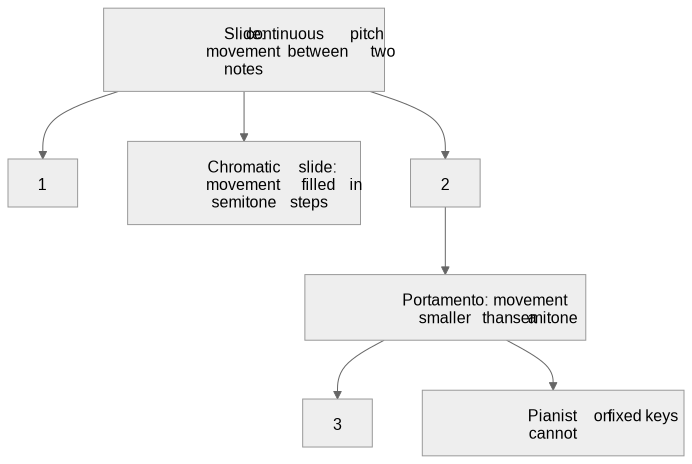
1Box 1
2Box 2
3Box 3
There is more to this lesson
The full lesson goes on to check your understanding and help you earn the marks. Create a free account to carry on, with your progress saved.
A week of Premium from your first lesson · Then the free plan continues · No card, no charge
Test your understanding of Appendix 3: Musical vocabulary - Dynamics and performance matters: A slide between adjacent notes of a chromatic or diatonic scale. The terms glissando and portamento are to some extent interchangeable, but a portamento involves movements smaller than a semitone (such as a singer can achieve but a pianist cannot)
Active recall beats re-reading. Take an instant quiz now to test what you’ve learned and lock it into long-term memory.
A week of Premium from your first lesson · Then the free plan continues · No card, no charge